Survival Strategies · HP Lesson 6
The 'Crying Kid' Strategy: How to Survive a High-Stakes Deal You're About to Lose
A bit of background:
It was a sales case in my first job at a security software startup, as discussed in the previous post here on Sales OS.
- Client: A global logistics enterprise
- Solution: Database security solution and implementation
- My Sales Experience: 1 year
When the Guardians Leave
In the middle of the sales cycle, my CEO resigned for personal reasons. Shortly after, the Senior Account Manager, with 10 years more experience, also left.
I was a junior salesperson, and suddenly, this massive logistics account was mine.
I paid a courtesy visit to the client's project committee with my engineer. My reading of the signals at the time? The requirements were clear, but there was zero sense of urgency. No timeline.
Naturally, I set the account aside.
The 9:15am Wake-up Call from Client
A few months later, at 9:15 a.m., before my morning coffee had taken effect, I received a call.
The Financial Manager (FM), one of the committee members, asked:
"Hello, Amice, how are you? By the way, are you still working at xxx Security?"
That line jolted me awake instantly.
Had I become invisible? My client thought I had resigned or been fired?!
But what had I done wrong? I had simply deprioritized the account because there was no urgency signal.
I stuttered, "Yes, yes, of course...I am still here. How are you? Is there something I can help with?"
He continued: "YYY [a competitor] has already submitted a proposal. Are you still interested in providing yours?"
I arranged a meeting immediately.
Who My Competitor Is and What She Did
The competitor turned out to be my ex-colleague — the senior salesperson with 10+ years more experience than me. Under her employment contract, she was prohibited from approaching former clients. But realistically, who can enforce that?
Compounding the problem: the Security Manager (SM), another committee member, was her personal friend. The FM told me privately that the SM had openly declared to the committee: "I will fully support implementation if we go with YYY."
The FM also mentioned that my competitor believed she was the only vendor in the running and had priced her proposal expensively.
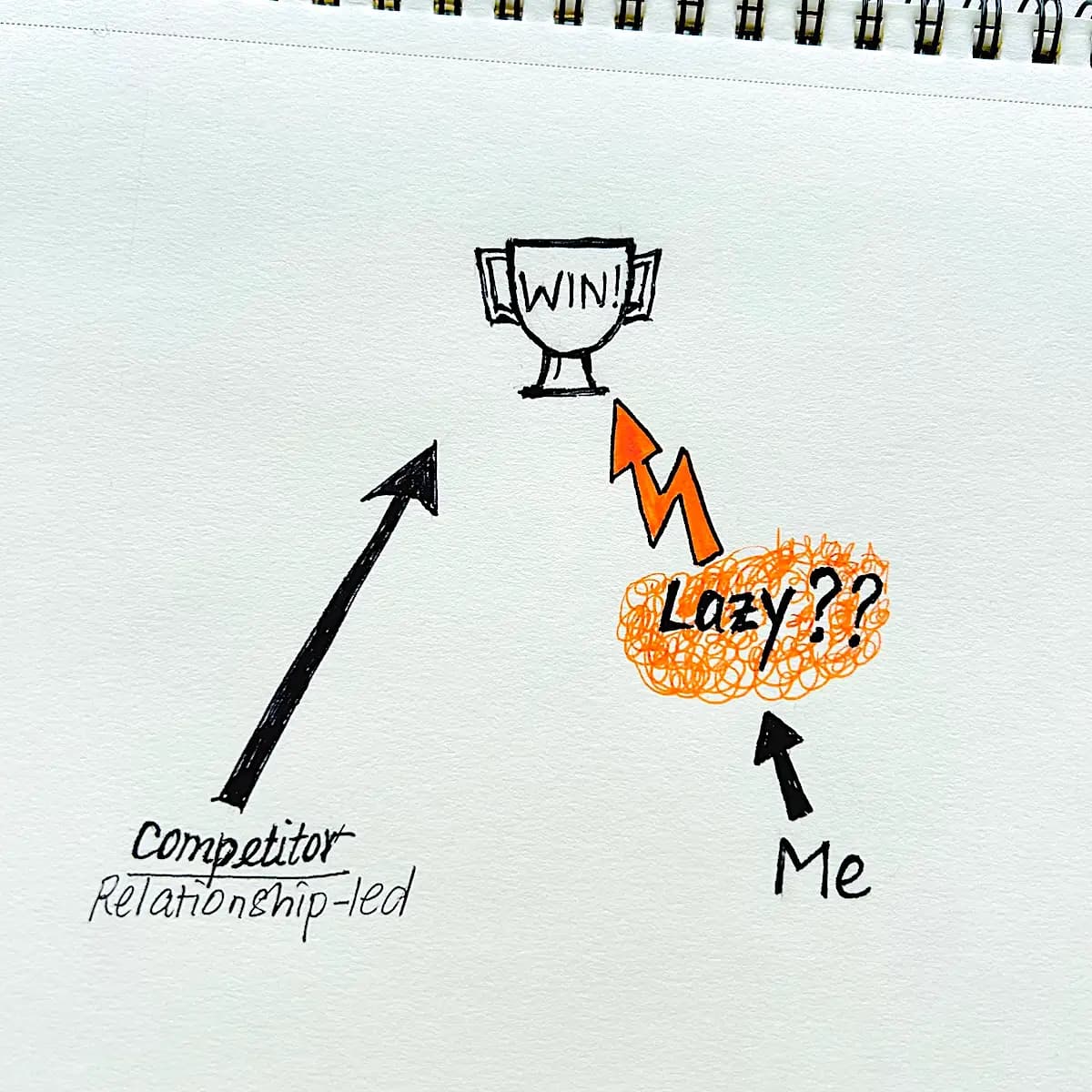
One more thing: the FM told me she had described me to the committee as "lazy."
The FM did not reveal why he wouldn't just go ahead with competitor YYY and why he was keen to pull me into the picture.
But I could read between the lines.
The financial team needed a data protection solution to hit a compliance KPI. The competitor's pricing was likely inflated because she assumed no real competition existed. The FM clearly didn't want a single-vendor situation — he wanted to reclaim budget control. And I was the lever he needed.
I have mixed feelings about this situation. But it was not the time for self-reflection. The only matter I should focus on is "How do I save the deal?"
Fighting a Losing Battle
Was I likely to lose?
Probably.
I stopped relying on "gut feeling" and looked at the dimensions of the deal:
3D Qualifiers — What is 3D Qualifier?
- Demand: Urgency was now 10/10. They had to sign.
- Dollar: I asked the FM for his "expected budget." I decided that even if I lost, I would submit a price so low it would destroy the competitor's profit margin.
- Dynamic: The SM was against me, but the FM was my Coach. I needed to move the decision higher up the chain.
Leverage My Management (Again)
I have shared my story here, where my CEO helped me at the 10th meeting. Though he left, I still had my CFO.
My luck this time: CFO to CFO.
The Finance Manager facilitated my selling by helping to arrange a meeting with his boss, the CFO. My CFO committed to the client the best support.
You may ask: my competitor could also play the same game as I did. But surprisingly — no.
Crying Kid Gets Candies
In some cultures, we say, "The crying kid gets the candies." In sales, if you are being unfairly excluded, you have to make a professional "fuss."
I used Executive Leverage. I didn't have a CEO, so I brought my CFO to meet the client's CFO. C-Level to C-Level. My CFO gave a firm commitment to the project's success that a rogue ex-employee couldn't match.
Then, I played the "Crying Kid" card with the Financial Manager. I asked him directly:
"I apologize for the delay. I wasn't signaled that the discussion had resumed. But is there a reason the team is only accepting one vendor? Is it because we are a local firm and perceived as 'too small' to support you?"
By "crying" about being the underdog, I forced the committee to justify why they were ignoring a viable, cheaper, local alternative.
The Result: An Ugly Win
We went back to the committee. Under pressure from the CFO and FM, the Security Manager — the competitor's friend — had to back down.
He told the room: "I will not have a standpoint for this project from now on. I am neutral."
The "Crying Kid" removes the competitor's strongest strength effectively: the personal relationship.
My team continued with the selling process, and finally, we won the contract.
Deep Reflection
I won the deal.
FM hit his KPI for data privacy.
I hit my KPI as well.
My commission was safe.
But I won badly. I was strong in handling difficult situations, but I was the one who made it difficult.
Because of my "laziness" in the early stages, I had to use "risky" tactics that upset a key stakeholder and forced a price war.
To be precise, that laziness wasn't about a lack of work — it was a lack of a planned approach. I had no system to tell me when to revisit the case or how to read the silence.
That "Ugly Win" changed how I approach every account today. It made me realize that gut feeling is not a strategy.
I'll be breaking down the two biggest lessons from this mess in my next posts:
- The "6 Roles, 2 Intents" Mapping: the stakeholders in your B2B accounts
- Have You Ever Had to "Burn" a Stakeholder to Win a Deal?
Let's discuss more in the coming two articles.